Nguyen Hoai Nam and Phan Bui Bao Thy, two Vietnamese state media journalists, were convicted last April for exposing corruption in the government. Nam was sentenced to three years and six months in prison under Article 331 of the penal code for reporting on how authorities mishandled a corruption case at the Vietnam Internal Waterways Agency. Likewise, Thy was given one year of “non-custodial re-education” for criticizing and defaming state leaders on social media.
These two individuals are the latest victims of the Vietnamese government’s long-standing, ongoing, and intensifying crackdown on press freedom and freedom of expression. Regrettably, these incidents are not solely unique to Vietnam; the status of journalism, the safety of journalists, and the prevalence of accurate and reliable information are being challenged, questioned, and undermined worldwide.
The 20th World Press Freedom Index
On May 3, 2022, Reporters Without Borders (RSF) released its annual World Press Freedom Index which monitors and compares various trends and shifts in the global landscape of journalism and the spread of information in 180 nations and territories. These 180 countries are then scored from 0 to 100 and ranked based on two general components:
“a.) a quantitative tally of abuses against journalists in connection with their work and against media outlets;
b.) a qualitative analysis of the situation in each country or territory based on the responses of press freedom specialists (including journalists, researchers, academics, and human rights defenders) to an RSF questionnaire available in 23 languages.”
A country that scores 85-100 is considered to have good press freedom. If it gets 70-85, it is considered satisfactory. Points between 55-70 are classified as problematic while a total of 40-55 is seen as difficult. Lastly, scores from 0-40 indicate a country where press freedom is virtually non-existent and classified in the Index as very serious.
These points are distributed into 5 contextual indicators that attempt to describe the press freedom situation in any given country.

The first is a political context which can be summarized as the relationship between the media has with politicians and governments in general. It also refers to how the state respects the autonomy of journalists and the press as a whole.
The legal framework is the second indicator, which concerns the “legislative and regulatory environment for journalists.” This category deals with the degree by which media practitioners can work without risk of being hindered by laws or regulations, the ease of access to information for journalists, the ability of journalists to protect their sources, and the presence or absence of impunity for anyone who harasses or commits acts of violence against the press.
The third is economic context, which refers to the economic restraints of a particular country and how these influence government policies regarding media, the actions of various non-state actors such as advertisers and commercial partners, and the powers and limitations of media owners who want to promote their business interests or defend them from outside attacks from the state or otherwise.
The sociocultural context of a country is the fourth indicator and this refers to the many social and cultural difficulties present in a given country. Attacks on the free press on issues such as gender, class, ethnicity, and religion or pressuring journalists to stop questioning those in power due to these actions going against the cultural norm will lead to a lower score in this category.
The last contextual indicator is the safety of journalists in a given country. This rubric looks at the risk of bodily harm, psychological or emotional distress, or any damage to the livelihood or living conditions that a media practitioner may face in the performance of his or her duties; the more harassment journalists face, the lower the score a country gets in this category.
The country rankings and point system are meant to provide an accurate set of quantitative data to reflect the world’s actual state of press freedom. After these 180 nations and territories were measured against these standards in this year’s Index, the results were more than a little disheartening.
Overall Worldwide Trends
The 20th World Press Freedom Index findings present a reality where the unregulated and uncontrolled spread of misinformation, propaganda, and fake news has led to the slow decay of press freedom worldwide.
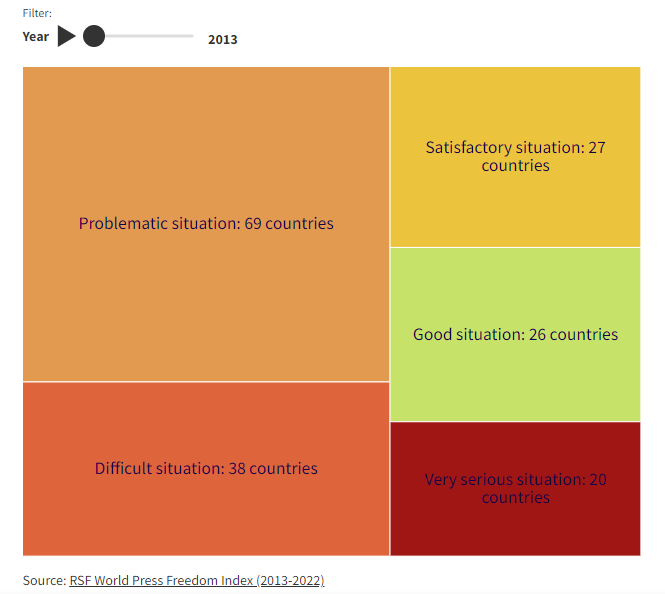
In 2013, 26 countries were considered to have good press freedom, and 27 were said to be satisfactory. Meanwhile, 69 countries were problematic, 38 were difficult, and just 20 were considered to have a very serious situation.
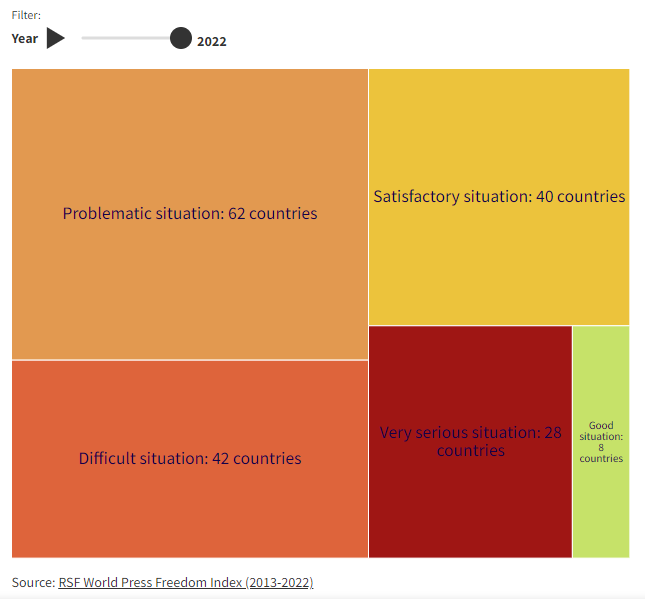
A mere nine years later, the situation is vastly different. In 2022, only eight nations are considered to have a good press freedom situation, while 40 other countries have reached the threshold of being classified as satisfactory, which is little cause to celebrate. Even though the number of problematic countries also decreased to 62, the number of territories under the difficult and very serious classifications has risen to 42 and 28, respectively.
The Index claims that this change is due to the spread of opinion media in the more democratic-leaning countries, the prevalence of disinformation spread by social networks, and the methods used by more despotic and authoritarian regimes to control the media, free press, and online platforms in their territories.
RSF argues that all these factors have led to polarization or a stark internal division among the people in most countries on their list and a growing schism between more democratic states and their despot-run counterparts.
This divide can be seen in how the countries are ranked. In general, nations in Northern America, Southern Africa, East Asia, Oceania, and Western Europe tend to be ranked higher on the Index than countries in Latin America, Central, and Northern Africa, Southeast Asia, Central Asia, Eastern Europe, and the Middle East.
Current Status of Vietnam
Press freedom in the Asia-Pacific region has “deteriorated dramatically” in recent years due to structural issues and institutional changes in some governments, the rise of authoritarianism in several nations, and the growing influence of large industrial groups in more democratically-leaning territories.
Vietnam, a part of this region, once again places extremely low in the new World Press Freedom Index with a score of 26.11, rising one rank higher than last year from 175/180 to 174. The country is described as a place where “traditional media [is] closely controlled by the single party” and where “[independent] reporters and bloggers are often jailed.” RSF also states that Vietnam is currently the world’s third-largest jailer of journalists.
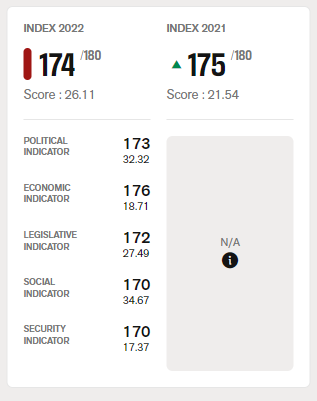
In terms of political context, Vietnam ranks 173 out of 180 countries. It is a one-party state where the ruling Communist Party aims to control all facets of society. RSF specifies the existence of a 10,000-person strong anti-cybercrime unit known as Force 47, which is tasked with protecting the Party from all forms of online attacks and criticism. The Index also notes the country’s 2019 Cybercrime Law requires foreign social media platforms to store all data of Vietnamese users, which is given to the authorities when requested.
Vietnam ranks 176 out of 180 in terms of its economic situation. The Index notes that the State is a significant shareholder in all of the country’s media outlets and ensures that nothing “objectionable” is released or published in mainstream media.
The country’s legislative context is also dismal; Vietnam ranks 172 out of 180. Noted in the Index are Articles 109, 117, and 331 of the Penal Code, which are often used by the State to harass and imprison government critics and activists for up to 20 years.
The sociocultural context of the nation also disappoints, with Vietnam being ranked 170 out of 180 in 2022. RSF lists several “sensitive” issues which remain taboo to discuss in public. These include human rights, government corruption, the country’s relationship with China, and questioning the legitimacy of the Communist Party.
However, the Index also notes that discussions about less sensitive issues, such as gender rights and the environment, are slowly becoming accepted.
In terms of the security and safety of journalists and other media practitioners, Vietnam ranks 170 out of 180. RSF notes that fear and terror are used by the State to silence independent journalists and alternate sources of information.
The Index specifies the suppression of media outlets, such as Bao Sach (Clean Newspaper) and the Independent Journalists Association of Vietnam (IJAVN). Also mentioned is the imprisonment of internationally acclaimed writer and journalist Pham Doan Trang, who is currently serving nine years in prison.
Vietnam continues to be a nation under the State’s tight control, which controls all facets of mainstream media. Alternative narratives and dissenting opinions on current events only come from independent bloggers and journalists who remain at constant risk of harassment and imprisonment.
The country has likewise become a hotbed of misinformation due to both the action and the inaction of the State regarding the spread of fake news.
Yet, despite the risks involved in their chosen line of work and the ongoing persecution of their peers, independent news outlets such as Luật Khoa and The Vietnamese Magazine continue to work in defiance of government censorship and control. While press freedom in Vietnam remains bleak, independent media in the country continues to stand as keepers of truth against the lies peddled wholesale by the State.
RSF’s 20th World Press Freedom Index can be found here.
The full questionnaire of the 5 contextual indicators used to score a country’s press freedom can be found here.
References:
- Committee to Protect Journalists. (April 8, 2022). Vietnamese journalist Nguyen Hoai Nam sentenced to 3.5 years in prison. Retrieved May 12, 2022, from https://cpj.org/2022/04/vietnamese-journalist-nguyen-hoai-nam-sentenced-to-3-5-years-in-prison
- Committee to Protect Journalists. (April 11, 2022). Vietnamese journalist Phan Bui Bao thy sentenced to ‘re-education’ over social media posts. Retrieved May 12, 2022, from https://cpj.org/2022/04/vietnamese-journalist-phan-bui-bao-thy-sentenced-to-re-education-over-social-media-posts/
- Reporters Without Borders. (April 11, 2022). Two Vietnamese state media journalists convicted for exposing corruption. Retrieved May 13, 2022, from https://rsf.org/en/two-vietnamese-state-media-journalists-convicted-exposing-corruption
- T. H. Long (May 6, 2022). Article 331 of the Vietnam Penal Code is completely redundant. The Vietnamese Magazine. Retrieved May 13, 2022, from https://www.thevietnamese.org/2022/05/article-331-of-the-vietnam-penal-code-is-completely-redundant/
- L. Nguyen, (May 12, 2022). Four reasons why Vietnam is a hotbed of misinformation. The Vietnamese Magazine. Retrieved May 13, 2022, from https://www.thevietnamese.org/2022/05/four-reasons-why-vietnam-is-a-hotbed-of-misinformation/
- Reporters Without Borders. (October 28, 2021). Combined jail terms of five Vietnamese journalists total nearly 15 years. Retrieved May 14, 2022, from https://rsf.org/en/combined-jail-terms-five-vietnamese-journalists-total-nearly-15-years
- Reporters Without Borders. (January 5, 2021). Vietnam: Three IJAVN journalists given a total of 37 years in prison. RSF. Retrieved May 18, 2022, from https://rsf.org/en/vietnam-three-ijavn-journalists-given-total-37-years-prison