


(This version was updated on September 12, 2020.)
Hoanh Village, a few days before the historic Dong Tam trial, is a place where the green rice fields are flowing beside country roads under the hot autumn sun. Vietnam’s national flag and banners commemorating the 75th anniversary of its National Day crowd the village gate.
I equipped myself quite well before I arrived in Hoanh Village, in both my mind and my technological tools.
“That place has many security police. Be careful!” – I was warned in a text message.
I have wanted to go to Hoanh Village during these days to be a journalist and practice the most basic ethical responsibility of our profession. I wanted to report the complete story about a historical event that will happen soon. I wanted to learn about the defendants’ families and what they yearned for, besides justice.
The village welcomed me with the typical peaceful beauty that many northern rural villages offer: a traditional market, big old banyan trees, rice fields, and winding roads. It was as calm as if it had never gone through the recent chaos it had experienced. There were no skeptical eyes staring at a stranger when I accidentally met villagers, or when they wholeheartedly showed me the directions to Mr. Kinh’s house.
They whispered to me, “So pitiful that house now, with only women and children left.”

There were no security police there; at least that was how I saw it. Yet, there were a few surveillance cameras placed on the awnings of opposite houses, which surprised me a little.
I met Mrs. Du Thi Thanh, the wife of Mr. Le Dinh Kinh, and Mrs. Le Thi Thoa, the fourth daughter of the couple, and their group of little grandchildren. In the house, which was pockmarked by police bullets, they told me stories about their father and husband. My questions were overwhelmed by their memories. The wife and daughter, and at times, both of them, unwittingly reliving stories about their husband and father as a man from their past. They told me the stories in tears, and there were moments of silence, and even some smiles. Before the attack, there were the peaceful times they had spent in the village.
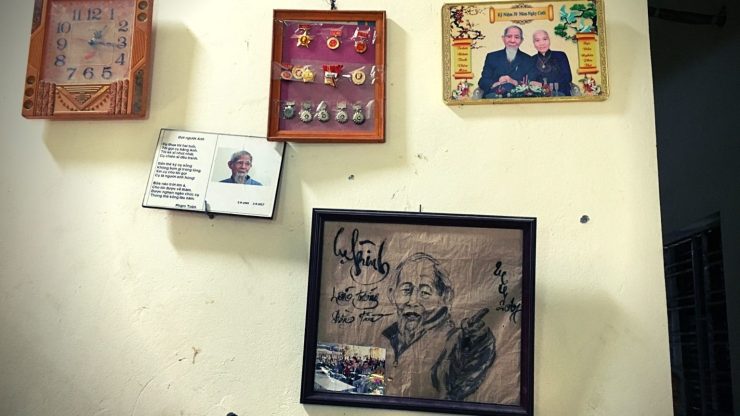
Mr. Le Dinh Kinh’s portrait and the medals that the government and the Vietnamese Communist Party awarded to him were hung on the wall opposite the main door. The same wall was marked by bullet holes, evidence of the attack one dawn last winter.
“These things, when he was alive, he treasured them so much,” Mrs. Thanh said, looking up at the medals. “He was given an award when he reached his 55th year as a Communist Party member.”
“What are your memories of him?” I asked the two women.
Du Thi Thanh:
Our house always needed a lot of upkeep, but he always forced me to take him to attend the Communist Party meetings in our ward. Before, he could go by himself, but starting in 2017, after his leg was broken during an assault by the police, he had to use a wheelchair. The first wheelchair was a gift from Mr. Chung (Nguyen Duc Chung – the former chairman of the Hanoi People’s Committee). Later, the Disabilities Association gave him another wheelchair. I remember when he tested out the second wheelchair, which he praised: ‘This one is smoother, my wife,’ he told me. ‘The first wheelchair came from Chung, I heard it was expensive, but the wheels were wobbly.’
I used the wheelchair to take him to his meetings, waited for him, and we would go back home together. People kept talking, one after another, which made me anxious because I could not know when the meeting would be adjourned.
More than that, the people did not obey any rules because when one person spoke, another would go outside to chat with others. It was just like the chatting done in the market. But it was only my husband and a few others who were thorough. I remember that he proposed to do roll calls to make sure the Communist Party’s meetings in our ward would have sound principles.
When we got home I was annoyed, and I told him if the Communist Party’s meetings were just like that, we should not go because we just sat there and did not benefit from anything. I told him that we were old and we should stay home to rest. However, he was angry with me. He said: ‘Why would you say that? I do not care if there were improper people there. I came because I want to be proper and exemplary.’
If you offer comments about his Communist Party carelessly, then you are bound to be berated.. From then on, if he asked me to take him to such meetings, I would go with him, and I stopped asking him to stay home.
Le Thi Thoa:
There are now only regrets…. Our father-daughter relationship had so many fights …. (She cried.)
I was never close to my father when he was alive. Among his children, I was the child that had so many opposite perspectives from him. I could not sit down and have a proper talk with him without us having a clash of opinions because we would fight right away after exchanging a few sentences. My father whole-heartedly trusted the Communist Party, and he believed in the Communist Party’s Secretary General Nguyen Phu Trong without condition. I warned him and told him: ‘Father, many officials nowadays have become corrupt.’ But my father scolded me and said we can’t tar the whole brush because the corrupt officials were only a small group and that they were the lower officials that covered their faults and smeared the Party.
I had wanted him to let go of the land dispute everytime I witnessed my father face grave danger. I cried and told him that I was scared. I stated that the Party had too many factions, and they could turn against each other to eliminate the opposition. My father responded to me that he was doing the right thing so he should not be afraid. He said the land of Senh field, where we had disputes with the government, belonged to the people of this ward. He also assured me that if he already made a mistake, the Party would have kicked him out a long time ago.
When he was in the hospital in 2017, some people gave him money when they visited him. He then gave the money to a policewoman and asked her to keep it for him. He always said: ‘(Nguyen Duc) Chung already said so (that the government would never prosecute Dong Tam villagers). Or, he would say ‘the people from the city had promised me already (to not prosecute),’ and that ‘things have to be reported to Mr. (Nguyen Phu) Trong because the Party would then be transparent.’ I was so mad, I stopped talking to him, ignoring the old man’s ideology.
From the time when he was still a local official right up until to his retirement, I saw him as a person who spent so much time volunteering for the community. I felt uneasy. He only cared about the ward and the village’s everyday issues, leaving my mother to take care of our household alone. As years passed , the Mieu Mon land dispute documents passed through the hands of many leaders , but he stored them all in his head. He memorized all of them, line by line, without fail, without a need to look at the papers.”
Du Thi Thanh:
When he was an official, he only focused on his position and worked for the ward and the village. Even when his wife and kids suffered, he took no notice . When he retired, he began to farm the field. I guess he farmed to compensate his family because there had been so many years that he neglected us. The village people passed by our field and would tease him: ‘Oh, Mr. Kinh, Mr. Kinh. You were an official, why are you only now putting your head to the field?’
Le Thi Thoa:
Other people who were government officials had so much land. My father worked at the top positions in this ward, but my family didn’t even have a rice field when he retired. I remember that my parents would come to some undocumented land that nobody cared to claim . From dawn to dust, they would go there to work on that land, clearing, ploughing, digging, furrowing and cultivating the land till it was ready to be used for planting food crops. . They worked so hard and spent so much time on that field only to have their sweat and blood rewarded by a call from the government to donate all the cultivated land to the ward when harvesting time came. Is that reasonable? But then I have never heard my father blame the Party or curse the government. He only scolded me. (She smiled.)
I was irritated and slightly annoyed at the absurdity when I read online that people cast doubt on the source of money my father received from overseas, indicating it was from the reactionary forces. Truth be told, my father would forever continue believing in the Communist Party until his last dying breath.
If he truly believes that something is right and is not against his conscience, my father would fight to protect it till the very end. He used that mentality to protect the Senh field and the Communist Party.
Du Thi Thanh:
Until his last days, even after witnessing so many city officials do an about-face, he still believed in his Party. I worried for his safety, but he chided me: ‘You do not need to worry about me. I am a Communist Party member. A Party member must stand up and take care of the people. If we ignore the truth and don’t speak up, we are guilty in front of the people.’
I remember when he was young, he would pedal with only one leg, but he was incredibly fast. He would bike across the fields to go to the town center for a meeting. He was disabled in one leg, but he was talented so it helped him to become the head of the ward police force. He could only stand up on one leg, but he took care of all of the ward’s work thoroughly. The people in this ward respected and loved him.
Le Thi Thoa:
I recall that he told us he had played soccer when he was young and sprained his leg. Unfortunately, he did not receive proper treatment, which led to a permanent disability later on in life. My father was always so busy with work. When he was riding his Thong Nhat branded bicycle or when he got a ride on a motorbike to go to the district office, he always had to stretch out his disabled leg. Even having his meals or a cup of tea, he could not fold that leg. When he walked, it seemed as if he was dragging it along.
Du Thi Thanh:
But they shot and blasted his disabled leg.
Le Thi Thoa:
Dad died such an inconsolable death.. What is there left when all of the men in this house have been arrested. We can only pray to Heaven. We looked up at the sky and cried our hearts out about the injustice. When we fixed part of our home after the assault and repaired the damage caused by the police attack , our mother wept until she passed out because she was so heart-broken that our family now was left with only women and young children. My father’s belief caused all of that. If I knew in the end that our family would be this broken, I would have made more of an effort to stop my dad from disputing the land with the government. You should throw away everything, dad!” (Le Thi Thoa sobbed)
“We will walk (to court) from our village”
Du Thi Thanh:
My sons, my grandsons, are all in prison. It has been more than eight months, and our family did not receive any news about them. My son Chuc, did the wound on his head heal? Ten days after he was arrested, his wife gave birth to a son. His wife sent him a picture of the newborn baby, but the prison officials did not allow him to receive it. I believe that Doanh got shot in the arm, how is he now? Uy, and then Cong. My sons and my grandsons are all working people. They each have their own family . Their wives now have to raise their children alone and unsupported. If I knew this in advance, I’d rather kept my mouth shut . I would have forced all of them to be silent. How could any piece of land be more precious than having a peaceful family life?”
Le Thi Thoa:
The rental car company did not accept our reservation (or that of any of the villagers) to rent cars to go to the trial. The company told us that the police had forewarned them. An official in our ward advised us to stay home because we would not be allowed to enter the Hanoi courthouse. But regardless, we will go there. We will walk from our village to Hanoi and attend the trial. My mother wants to see her sons and grandsons. The young children in our house want to see their fathers; the wives want to see their husbands. No one should be able to prevent us from doing that.
Du Thi Thanh:
What do I expect at the trial? I just want to meet my sons and grandsons. I want them to issue a death certificate for my husband. He passed away more than eight months ago, but we have yet to receive the death certificate. The officials from our ward forced me to state the reason for his death as ‘died at home.’ No. That was not right. Mr. Le Dinh Kinh was shot to death at home. A bullet entered near his heart. Two bullets were fired into his head. His left knee was shattered. That was how my children’s father died. The bloodstain is still in our room, how could they lie like that?
The bloodstain is right here. It is very stubborn though, I could not wash it off.
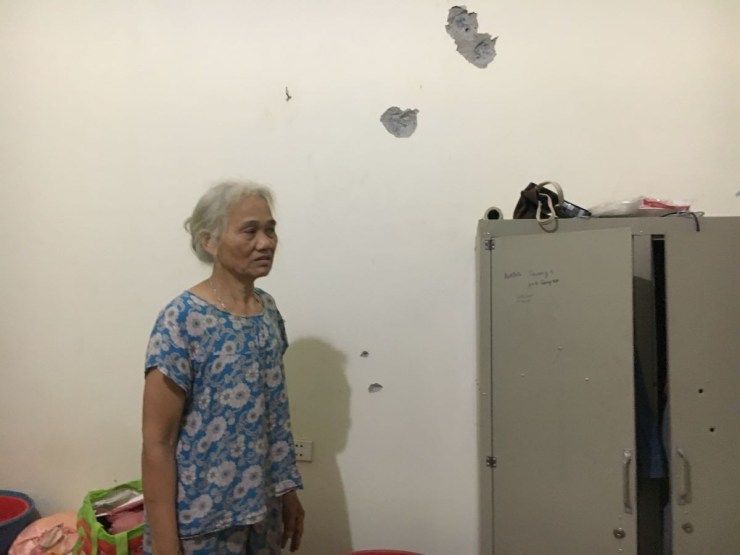
“Just stay still here, I will go downstairs and get you a wet cloth to help you breathe better.” That was my last sentence to my husband. The fumes were so heavy. I was going back to his side when someone took my arms and dragged me away. When I came back home, the room was covered in blood. Our home was shattered. Can you see this door jamb protruding out? A bullet is stuck in it.
***
Mrs. Thanh relived the story as she walked me around her house.
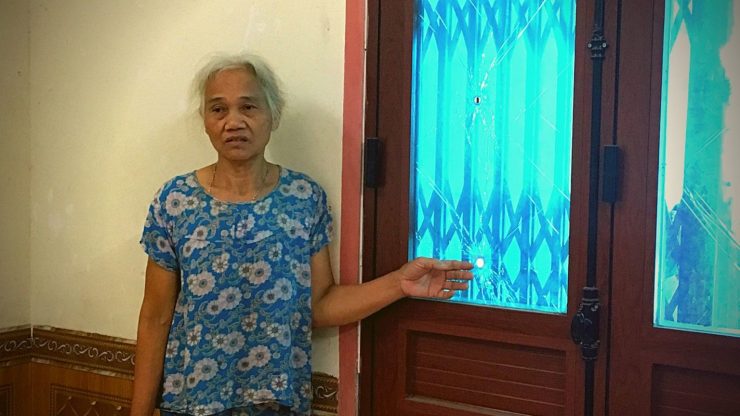
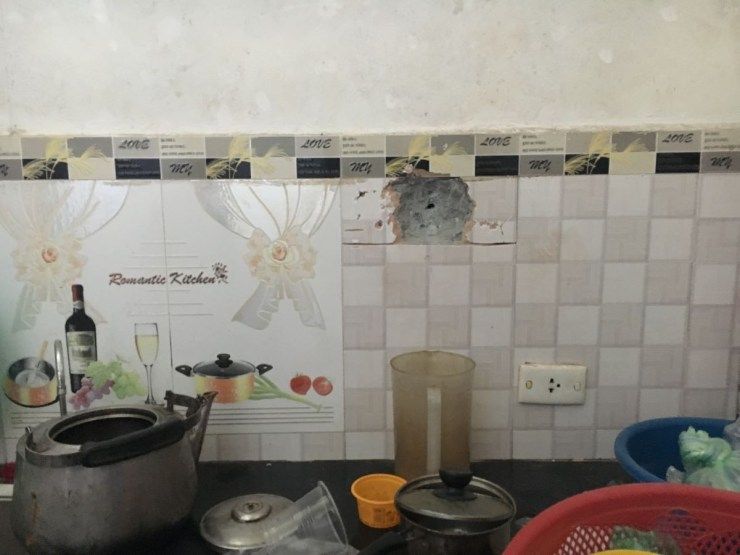
I could see the remnants of bullets fired through their glass door. Their closets were also shot up, and the wall had a massive crack. There were areas of newly patched cement, but others were left untouched. Evidence of bullets was everywhere, substantial bullet holes, smaller holes, on the first floor and the second floor. They were also in the kitchen and the living room. There were also black stains on the floor, which Mrs. Thanh suspected it came from the tear gas.
She was walking with her hunched shoulder, her hair all white. Just like her daughter, she doesn’t believe in anyone because “only Heaven could help my sons and grandsons” during the trial starting next Monday. The two women did not say words like “justice”, “righteousness”, or “fairness” when they referred to the trial as I had imagined they might. They did not expect too much, just the simple wish to be able to see their loved ones and to somehow brush each other’s hands at the trial hearing.
I just wanted to write down their stories, documenting ordinary farmers who unfortunately have family members caught in the justice of law and now tried as defendants. Although I guaranteed that I would not write about the land dispute issues or give speculation on which side is right or wrong, not a single newspaper in Vietnam accepted to publish this article.
On September 7, 2020 when the Dong Tam trial begins, where would we see the faces of the mother, wives, and children of the 29 defendants from Hoanh Village and the Mit Village, both located in Dong Tam Ward? Broadcast on television? Captured on cameras or on the cover of newspapers? Would the state-owned media specifically describe these women as who they are and not as people from the reactionary force?
I hope that my imagination about their fate during the Dong Tam trial will not turn real. I also hope that there will be a place, a time to safely and freely tell their stories. Their voices have been silenced for so long.
***
The original article was written in Vietnamese by May and published in Luat Khoa Magazine. The English translation was done by Karie Nguyen.


